Strassen, minus one
An AI coding agent found a way to multiply two 4x4 matrices using 48 scalar multiplications, one fewer than the recursive method math had used since 1969.
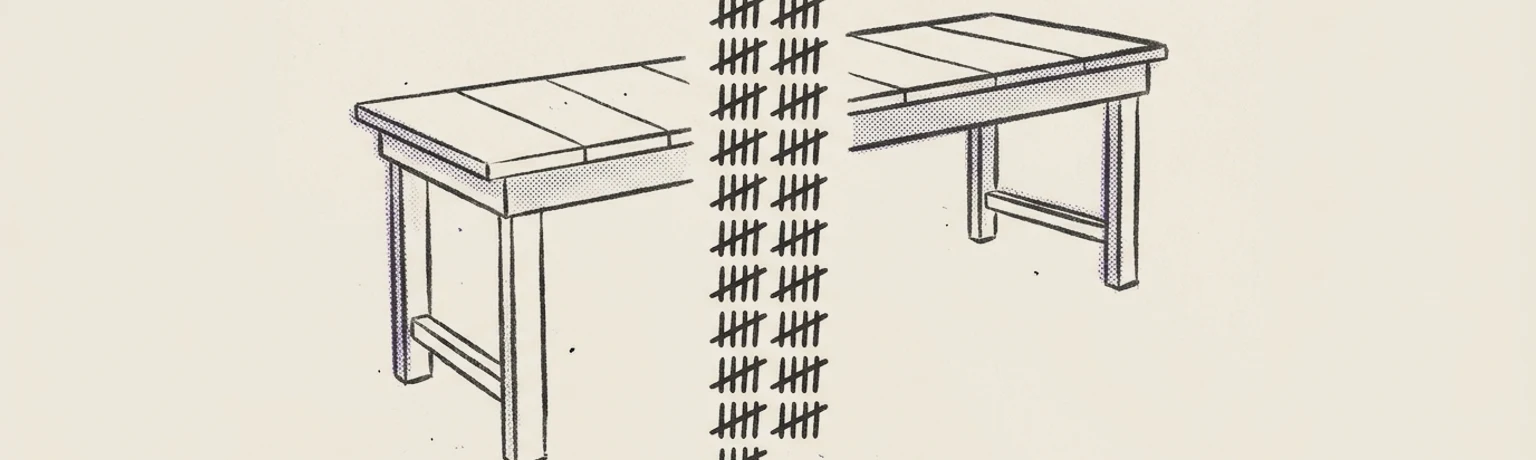
Multiplying two 4x4 matrices the schoolbook way takes 64 small multiplications. In 1969 Volker Strassen showed a recursive trick that gets it to 49, and there the count sat in the general case. DeepMind's AlphaEvolve — an agent that mutates and tests code over and over, with Gemini proposing edits and an automated checker keeping only the schemes that actually compute the right product — found one that does it in 48.
DeepMind's own blog claimed only an improvement on 'the best known in this setting' — the 'unbeaten since 1969' version was added downstream.
One fewer multiplication sounds trivial. It isn't nothing: matrix multiplication is the operation underneath essentially all neural-network compute, and a recursive scheme reuses its saving at every level, compounding as the matrices grow. But the headline that traveled — 'the first improvement in 56 years, found by no human' — is wrong, and the gap is where the real result hides. A mathematician named Waksman beat Strassen's 49 with 46 back in 1970; his method just assumed the numbers commute and that you can divide by two. AlphaEvolve's 48 holds without those assumptions, the awkward non-commutative case where Strassen's 49 was the bound to beat.
So the genuine result is narrower and sturdier than the hype: not a record untouched since the moon landing, but a real new rung on an active ladder — and the rung was placed by a search agent rather than a person. The lineage matters too. DeepMind's earlier AlphaTensor had only undercut the count in binary arithmetic; doing it over the complex numbers is the new step. Within a month an academic team reproduced the scheme and stripped out the complex-number requirement entirely, which is roughly how a healthy result is supposed to age.
The lenses
The facts
How this connects
Tap a node to open it