Longevity & Health
Aging biology, GLP-1, diagnostics, and ML moving into the clinic.
State of the world · updated June 2026
Right now: GLP-1 drugs are the breakout, with effects being mapped well beyond weight. Epigenetic clocks are maturing into usable readouts, and AI-bio labs are shortening the discovery loop.
Watch: whether partial cellular reprogramming stays safe outside the lab, and how much of the GLP-1 "everything drug" story survives larger trials.
Start here · the primer
The throughline is convergence: aging is starting to look engineerable, and ML is the microscope. GLP-1 drugs cracked behaviour change; epigenetic clocks gave a readout; foundation models are compressing the discovery loop.
Top finds
All finds →The stream, scoped to this megatrend. Your sort, not ours.
Overall = breadth + depth + substance + ½·novelty + ¼·delight (Day & Week add a small freshness boost that halves each week; Month & All-time are pure merit)
Quality marks✪Landmark (top-shelf overall)❖Solidshown at a perfect 5

DNA that shouldn't touch
Across 40 donated human brains aged 20 to 100, the genome's three-dimensional folding loosens with age until stretches of DNA that should stay apart drift into contact and switch on inflammation.
The edit that lowers cholesterol
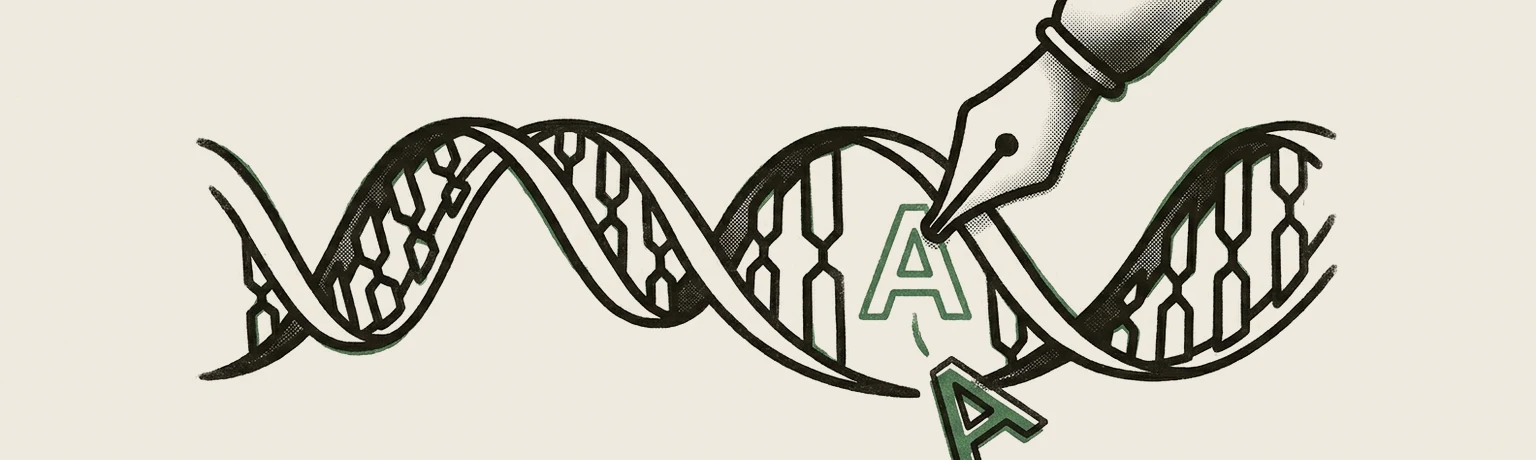
A single IV infusion rewrote one letter of DNA in the liver and dropped LDL cholesterol as much as 62%, sustained for a year.

SleepFM
A sub-million-parameter model reads one night in a sleep clinic and forecasts years-ahead risk for 130 diseases, from dementia to breast cancer.

The oncogene pulls the trigger
A protein circuit delivered as mRNA detects the jammed-on Ras protein behind roughly a quarter of human cancers and turns that signal into an order to self-destruct.

The brain's back door
Stanford researchers read the random mutations inside single cells like barcodes and caught bone-marrow immune cells crossing into the aging brain, where they make up a large share of the resident immune cells and appear to affect how well the brain clears Alzheimer's plaques.


























Concepts
All concepts →The ideas behind this megatrend — explained from the ground up.
3D genome architecture
How DNA physically folds inside the nucleus — which distant sequence regions sit close together and which are kept apart — determines which genes a cell can actually switch on.
AI Disease Risk Forecasting
Using machine-learning models trained on biological signals — sleep, wearables, genomics, labs — to estimate an individual's probability of developing a disease before symptoms appear.
AI drug discovery
Using machine learning to find and optimise drug candidates — predicting which molecules will bind a target and survive the body before synthesising them.
AI for materials discovery
Using machine learning to predict which new materials will have desired properties before synthesizing them in a lab.
Autophagy
The cell's internal recycling system — it wraps damaged proteins and organelles in a membrane sac, then digests them for parts.
Biological foundation model
A large sequence model pretrained on DNA, RNA, or protein data with the same self-supervised logic as a text LLM — learning biological grammar without task-specific labels.
Bioprinting
Building living tissue layer by layer using cells as ink, aimed at growing functional organs outside the body.
Biosecurity
The set of practices, policies, and technical controls that prevent dangerous biological agents — natural or engineered — from causing mass harm.
Cancer vaccine
A vaccine that trains the immune system to recognise and destroy cancer cells, either as treatment after diagnosis or as prevention before disease appears.
CAR-T therapy
A cancer treatment that takes a patient's own T cells, engineers them to recognise a tumour target, and reinfuses them as a living drug.
Clonal hematopoiesis
A blood stem cell acquires a somatic mutation that gives it a growth advantage, causing its descendants to gradually crowd out normal blood cells — silently, and without producing overt leukemia.
Continuous glucose monitoring
A wearable sensor that reads glucose levels in interstitial fluid every few minutes, giving a continuous trace rather than a single finger-prick measurement.
CRISPR
A molecular scissors system that lets researchers cut and rewrite DNA at a precise location in any living cell.
De-extinction
The project of reviving extinct species by reconstructing their genomes and growing viable embryos — using living relatives as the genomic and reproductive scaffold.
Drug repurposing
Finding new therapeutic uses for drugs already approved for something else — skipping the early safety work because it was already done.
Epigenetic reprogramming
Resetting a cell's age or identity by rewriting the chemical marks on its DNA — not the sequence, but which genes are switched on or off.
Far-UVC germicidal light
222 nm ultraviolet light that kills airborne pathogens in a room without harming the people in it.
Gene therapy
Treating disease by delivering working genetic instructions into a patient's cells — correcting, silencing, or replacing a defective gene.
Genomics
The reading, mapping, and manipulation of entire genetic sequences — the foundation for gene therapies, inherited-disease diagnostics, and drug-target discovery.
GLP-1
A class of drugs (semaglutide and kin) that mimic the GLP-1 hormone to regulate appetite and blood sugar — and increasingly studied for effects well beyond weight and diabetes.
Indoor air quality
The concentration of pollutants, particles, and gases inside a building, and how they affect the health and cognition of the people breathing them.
Inflammation and Atherosclerosis
Arterial plaque is not a passive lipid deposit but an active inflammatory lesion — immune cells infiltrate the vessel wall, and chronic inflammation drives plaque growth, instability, and rupture.
IVF embryo selection
The process of testing embryos created via IVF for genetic or chromosomal abnormalities — and increasingly, polygenic traits — before transferring one to the uterus.
KRAS oncology
A mutated signaling protein that locks cells into a permanent "grow" state — the most common single driver in human cancers.
Lipid nanoparticle
A tiny fat-based shell engineered to carry genetic cargo — mRNA, siRNA, or CRISPR components — into cells without triggering immune destruction.
Lipoprotein(a)
An LDL-like lipid particle with an extra sticky protein that raises cardiovascular risk independently of cholesterol — and whose level is almost entirely set by genetics, not lifestyle.
Liquid biopsy
Detecting cancer or other disease by sequencing DNA fragments shed into the bloodstream — a blood draw instead of a surgical tissue sample.
Medical imaging
Using equipment that records signals from inside the body — X-rays, sound waves, magnetic fields — to produce images doctors can inspect without surgery.
Mendelian Randomization
A method that uses inherited genetic variants as natural experiments to test whether a risk factor actually causes disease, not just correlates with it.
Neuroinflammation
Chronic, low-grade immune activation inside the brain that damages neurons over time rather than clearing a pathogen.
Nuclear medicine
Using radioactive isotopes to image the body from the inside or destroy diseased tissue — diagnosis and treatment driven by how cells absorb and emit radiation.
PCSK9
A liver enzyme that degrades LDL receptors — blocking it lowers LDL cholesterol sharply, and is now a target for gene-silencing therapies that may need only one or two doses.
Polygenic Risk Scoring
A single number — derived from hundreds of thousands of genetic variants — that estimates an individual's inherited predisposition to a disease.
Surrogate Endpoints
A measurable proxy — a biomarker or lab value — used in trials in place of the patient outcome it is assumed to predict.
Synthetic biology
The discipline of engineering living cells and organisms the way engineers design circuits — reading, writing, and rewiring genetic code to produce new functions.
Xenotransplantation
Transplanting organs or tissues from one species into another — today, gene-edited pig organs into humans.
Key entities
Discover all →The companies, people, tools and models doing the work — each scored on its own merits. Turn the dial.
Overall = breadth + depth + substance + ½·novelty
Organizations
9
Eli Lilly
Indianapolis pharmaceutical company, maker of the tirzepatide drugs Mounjaro and Zepbound and the Alzheimer's antibody Kisunla.
▸ Obesity drugs
Alphabet
Google's parent holding company, separating the core internet business from longer-horizon bets like Waymo, DeepMind, Verily, and Isomorphic Labs.
▸ Ai research
Insilico Medicine
AI drug-discovery biotech whose generative-AI platform both finds disease targets and designs the molecules against them; its lead drug for pulmonary fibrosis is the first where AI picked the target and drew the compound.
▸ Generative molecule design
Verve Therapeutics
Biotech company developing one-time in vivo base-editing medicines to permanently lower cardiovascular disease risk by silencing genes such as PCSK9 and ANGPTL3.
▸ Cardiovascular disease prevention
United Therapeutics
Biotech maker of inhaled and infused prostacyclin drugs for pulmonary arterial hypertension that is now engineering gene-edited pig organs for human transplant.
▸ Pulmonary arterial hypertension drugs
Life Biosciences
A clinical-stage Boston biotech using partial epigenetic reprogramming (the OCT4/SOX2/KLF4 factors) to reset aged cells toward a younger state, starting with eye disease.
▸ Age related disease
NewLimit
Longevity biotech using partial epigenetic reprogramming — delivering transcription factors to reset aged cells to a younger gene-expression state without changing their DNA.
▸ Reversing cellular aging
Nucleus Genomics
Consumer-genomics startup that sequences a customer's whole genome and returns polygenic risk scores for hundreds of conditions, plus a contested service that ranks IVF embryos on disease risk and traits.
▸ Consumer genome sequencing
Retro Biosciences
Longevity biotech targeting the cellular mechanisms of aging — autophagy enhancement, cellular reprogramming, and plasma dilution — to reverse age-related disease.
▸ Longevity biotechPeople
2
Brian Armstrong
Coinbase co-founder and CEO; also founded NewLimit, a longevity startup pursuing epigenetic reprogramming, and the open-science platform ResearchHub.

David Fajgenbaum
Physician-scientist who repurposed an existing drug to treat his own near-fatal Castleman disease, then co-founded Every Cure to find new uses for approved medicines with AI.
▸ Drug repurposing researchHardware
1
How this connects
Tap a node to open it